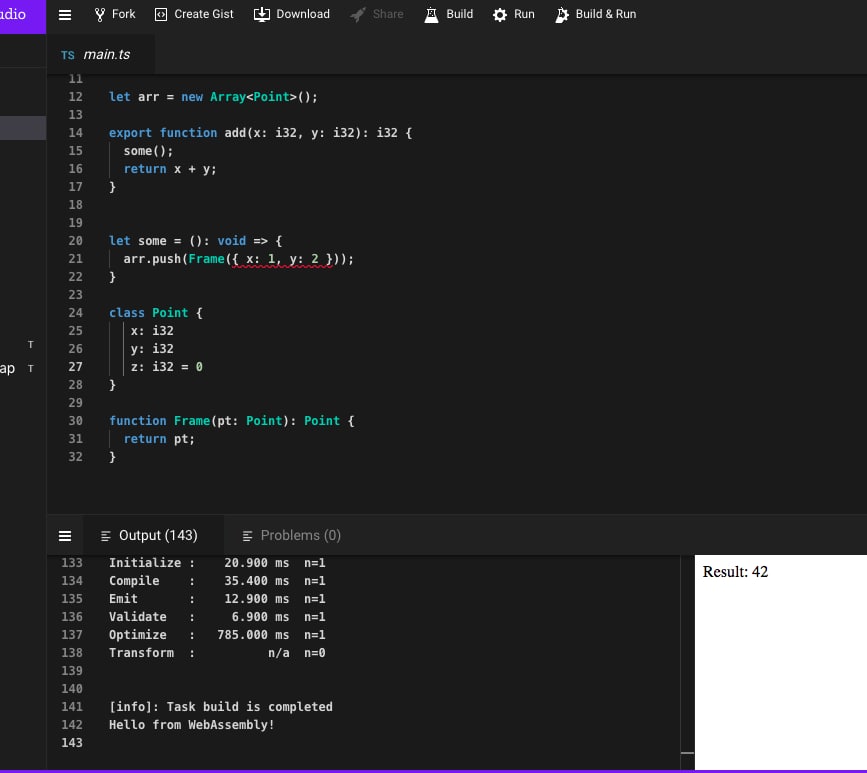
@maxgraey я правильно понимаю что AS пока не поддерживает объектные литералы с разным набором полей (автоматическое создание скрытых классов и попытка получить в рантайме инфу о наборе полей для свитч-обработки) и опциональных полей тоже нет ?
Я тут думаю над тем как представлять шаблоны компонентов средствами AS (без дополнительной компиляции). В реакте есть jsx где html по сути компилируется в вызов React.createElement() и такой шаблон
const SomeComponent = () => {
  return <div style={{
      width: 100,
      height: 200,
      backgoundColor: "blue"
  }}>
     <div style={{....}}></div>
     <div style={{....}}></div>
     <AnotherComponent prop1={..} prop2={}/>
  </div>
}

const AnotherComponent = () => {
  return <div style={marginTop: 10, ...}>
    ...
  </div>
}
эквивалентен такому дереву вызова функций
//хелперы
const Div = (style, children) =>  React.createElement("div", {style}, children);
const component = (Component) => (props) => React.creatElement(Component, props)

//компоненты
const SomeComponent = component(() => {
  return Div({
      width: 100,
      height: 200,
      backgoundColor: "blue"
     }, [
       Div({...})
       Div({...})
       AnotherComponent({prop1: ..., prop2: ...})
     ]})
})

const AnotherComponent = component(() => {
  return Div({style: marginTop: 10 }, [
    ...
  ])
})
И я уже довольно давно пишу на реакте таким образом (вместо транспиляции jsx вызываю React.createElement напрямую в атомарных компонентах).
Я правильно понимаю что в AssemblyScript не выразим подобный паттерн императивного построения структуры объектов с разным наобором полей (например в одном случае мы передаем width, height, в другом только paddingTop в третьем margin + justifyContent) ?
const SomeComponent = () => {
  return Frame({
   width: 500,
   height: 500
   children: [
     Frame({
       paddingTop: 10,
       children: [
         Frame({
           marginLeft: 10,
           justifyContent: "center"
           children: [...]
         })
       ]
     })
   ]
 })
}
или можно что-то придумать?
У меня пока есть запасной вариант представить шаблон компонента в виде вызова чейнинг-методов
const SomeComponent = () => {
  return Div().width(500).height(500).child(
    Div().paddingTop(10).child(
      Div().marginLeft(10).justifyContent("center")
    ).child(
      ...
    )
  ).child(
    ...
  )
)
но это не особо удобно и слегка непривычно и хотелось бы узнать можно ли что-то придумать с объектными литералами