[23:07] dmc4_dante: what is real e?
[23:07] HexOmega: what someone before me found was that as you move through resonant frequencies in a waveguide, the dielectric function of a sample will decrease, then increase
[23:07] HexOmega: it's the real dielectric function
[23:07] HexOmega: there's a real and an imaginary component. The real component tells you how a material displaces an electric field, while the imaginary tells you about the energy loss in the material
[23:08] HexOmega: but for my sample, the dielectric should be like a constant value of 3.82 for all frequencies, but mines jumping between like 3.3 and 3.9
[23:10] HexOmega: well in this case, the material is a fuzed quartz rod, which has been very well studied for years now
[23:11] dmc4_dante: okay Gordon, just tell us how close is the Unforseen Consequences chapter.
[23:12] HexOmega: real far away, since I don't do high energy
[23:12] HexOmega: lol
[23:12] HexOmega: this is super low energy
[23:12] HexOmega: microwave frequencies
[23:13] HexOmega: all of the different colored dots should have the same pattern as the orange ones, but the values should all hover like right on 3.82
[23:23] HexOmega: yea, the x and KU bands are close but not quite
[23:23] dmc4_dante: not my definition of a pattern, much less the same [*attached pic*]
[23:23] HexOmega: it shouldn't be that exaggerated
[23:25] dmc4_dante: doesn't that make green the main culprit?
[23:25] HexOmega: well it just says he's fucked up. Each of the colors are independent of the others
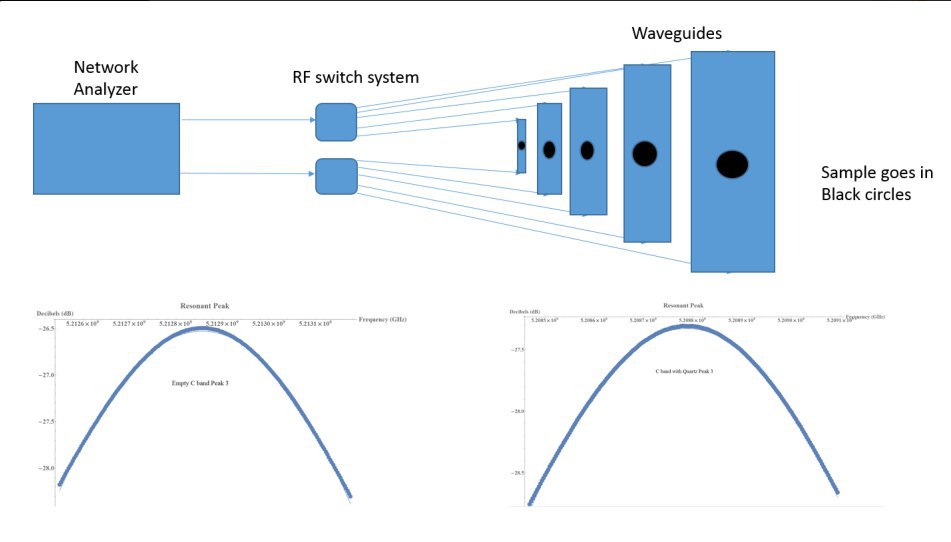
[23:26] HexOmega: each color represents a physical device; a different waveguide each
[23:26] HexOmega: we're using 5 different waveguides to measure our material. So the results from one don't really impact the others
[23:33] HexOmega: so the volume sample has to be way smaller than the cavity sample
[23:34] HexOmega: We're measuring the dielectric function of materials across a broad frequency range
[23:34] HexOmega: the empty cavities produce standing waves at very specific frequencies, and if you insert a sample into the waveguide, you shift where that oscillation occurs
[23:35] Ffion 🕈 堕天使: Does the geometry of the sample affect much?
[23:36] HexOmega: for example: the 3rd resonance of the C band waveguide is at 5.21285613525 Ghz empty, and with quartz in it it shifts to 5.20878750587 Ghz, and great question
[23:36] HexOmega: yea the geometry is super important
[23:36] HexOmega: if the system is not isotropic results get fucked
[23:37] HexOmega: and that's a current problem we have. The pipet we use to hold the liquid sample has a small solid glass rod on the inside on one side to help with the capillary action to suck up the sample
[23:37] HexOmega: and that will really screw up our results, so i'm also trying to figure out how to fix that